Why Are Premium Cookware Products Worth Buying from China?
The question “why are premium cookware products worth considering” deserves more than a discussion about price. China’s cookware industry combines advanced manufacturing with deep material knowledge. Many factories now produce tri-ply stainless steel pans, forged aluminum skillets, ceramic-coated cookware, and precision-molded lids. These products can deliver even heating, stable handles, and reliable performance when manufacturers follow strict quality controls.
Chef and cookware author J. Kenji López-Alt offers a useful principle: “Good cookware should give you control over the heat and the food.” That control becomes practical at home. A premium Chinese saucepan may spread heat across a thick base, reducing burnt sauce around the edges. A well-balanced wok can respond quickly when vegetables need high heat. Small details matter.
Still, “made in China” should never be treated as an automatic quality guarantee. It can describe excellent engineering or inconsistent production. Buyers should examine steel grades, coating durability, weld quality, factory testing, and traceable certifications. Independent inspections also matter. A beautiful surface can hide a weak handle joint. I have seen product descriptions sound impressive while omitting basic performance data.
This guide explores why premium cookware products are worth buying from China, especially when design standards, transparent sourcing, and factory experience work together. The best choice is not always the cheapest one. It is the pan that remains stable, safe, and useful after hundreds of meals. That sounds obvious. It is often overlooked.
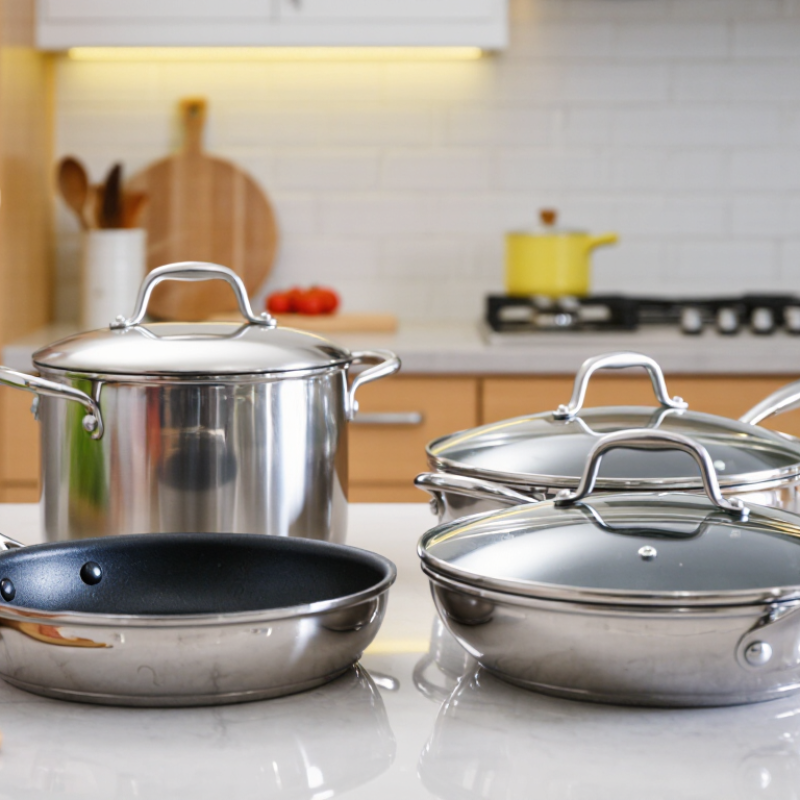
China’s premium cookware landscape is larger than low-cost mass production. It combines material suppliers, precision forming, surface treatment, and export testing within one industrial network. Grand View Research valued the global cookware market at about US$19.8 billion in 2023 and expects a 5.7% CAGR through 2030. That growth raises expectations for Chinese manufacturers. Premium buyers now demand stable heating, safer coatings, consistent geometry, and documented traceability. Not just attractive packaging.
In factory assessments, strong suppliers separate development samples from mass-production controls. Engineers check base flatness, wall thickness, handle torque, coating adhesion, and dishwasher resistance. Many plants also use automated polishing and statistical process control. ITC Trade Map, based on UN Comtrade data, places China among the leading exporters across cookware-related stainless-steel and aluminum household-article categories. The scale is meaningful. Scale alone is not quality.
A credible sourcing program should request material certificates, food-contact test reports, batch records, and pre-shipment inspections. Testing may reference EU food-contact rules or U.S. FDA requirements, depending on the destination. Buyers should verify the exact alloy and coating chemistry. “Nonstick” is not a complete specification. I have seen impressive prototypes fail after production changes.
That is the uncomfortable part. China’s premium landscape offers speed, engineering depth, and customization, but reliability depends on process discipline, not a factory tour.
Premium cookware from China can be worth buying when production standards are verified, not merely advertised. Experienced buyers inspect material certificates, factory records, and sample consistency before placing large orders. Stainless steel should match the declared grade, while aluminum bodies need stable thickness and controlled heat treatment. A polished surface may look impressive, but it cannot replace laboratory evidence.
Reliable factories test cookware for heat distribution, coating adhesion, handle strength, and corrosion resistance. Food-contact testing should cover relevant substances and follow the destination market’s requirements. Quality teams often check flatness after heating, lid fit, rivet security, and burr-free edges. These small details affect daily safety and cooking comfort. Traceability adds credibility. Batch numbers, inspection photos, calibration records, and retained samples help buyers investigate defects quickly.
Independent inspections can verify dimensions, packaging, and performance before shipment. Still, inspection is not magic. A factory may pass one sample and miss a repeated process weakness. Minor handle alignment issues can become costly returns. Clear specifications and regular audits reduce that risk, although they do not remove it. This limitation matters when judging premium cookware from China. A dependable supplier should answer technical questions clearly and provide evidence without hesitation.
Why Are Premium Cookware Products Worth Buying from China?
Premium cookware made in China can be valuable when its materials are clearly documented. High-grade stainless steel resists corrosion and keeps food-contact surfaces stable. Multi-layer construction places aluminum between steel layers for faster, more even heating. This reduces hot spots around the pan’s center. Copper can improve heat responsiveness, but it also raises cost and maintenance needs. Thickness matters too. A heavy pan is not automatically better.
Modern production technologies add practical value. Precision stamping creates consistent shapes and smoother rims. Forging can produce strong bodies with better resistance to warping. Induction-ready bases often use magnetic stainless steel bonded to an aluminum core. Laser welding may create cleaner handle connections with fewer exposed seams. Nonstick coatings require careful curing, adhesion testing, and abrasion checks. “Premium” should never depend on appearance alone.
A careful buyer should review food-contact testing, coating specifications, dimensional tolerances, and batch inspection records. Surface polishing should be uniform, without sharp edges or visible pits. Even expensive cookware can show uneven finishing. That is worth remembering. Factory quality systems also need regular verification, because one excellent sample cannot represent every shipment. Clear material certificates and traceable production records make Chinese cookware sourcing more reliable. Personally, I would test heat distribution and handle balance before approving a large order. Small flaws often become obvious during repeated kitchen use.
| Material or Technology | Typical Construction | Relevant Technical Data | Main Performance Benefit | Limitations and Care | Suitable Premium Applications |
|---|---|---|---|---|---|
| Tri-Ply Stainless Steel | Stainless steel interior and exterior with an aluminum core. | 304 stainless steel has a thermal conductivity of approximately 16 W/m·K; aluminum is approximately 205 W/m·K at room temperature. | Combines the durability and corrosion resistance of stainless steel with faster heat distribution from aluminum. | The stainless surface can discolor or develop heat stains; preheating and moderate heat help reduce sticking. | Frying pans, saucepans, sauté pans, and everyday oven-to-table cookware. |
| Five-Ply Clad Construction | Alternating layers of stainless steel and heat-conductive metals, commonly including aluminum. | Additional conductive layers can improve heat spreading and reduce localized hot spots compared with a single stainless-steel layer. | Offers greater rigidity, more even heating, and improved temperature stability during demanding cooking. | Usually heavier and more expensive; performance depends on the thickness and arrangement of each layer. | Professional-style sauté pans, stockpots, saucepans, and high-end induction cookware. |
| Hard-Anodized Aluminum | Electrochemically treated aluminum with a hardened oxide surface. | Aluminum provides high thermal conductivity of approximately 205 W/m·K; anodizing increases surface hardness and reduces reactivity. | Heats quickly, remains relatively lightweight, and provides better surface durability than untreated aluminum. | The anodized surface should not be aggressively scratched; compatibility with induction requires a magnetic base or plate. | Low-to-medium heat frying pans, grill pans, roasting pans, and lightweight cookware sets. |
| Copper-Core Clad Cookware | A copper layer enclosed between stainless-steel layers. | Copper has a thermal conductivity of approximately 401 W/m·K, substantially higher than aluminum and stainless steel. | Provides rapid heat response and precise temperature control for delicate cooking. | Higher material cost and weight; the exterior finish may require polishing if a bright copper appearance is desired. | Sauce-making, confectionery, fish, seafood, and other temperature-sensitive recipes. |
| Cast Iron | Thick cast iron body, either traditionally seasoned or coated with enamel. | Cast iron has a thermal conductivity of approximately 52 W/m·K and high thermal mass, allowing strong heat retention. | Maintains heat effectively for searing, frying, baking, and slow cooking. | Heavy and slower to heat; uncoated surfaces require drying and seasoning to help prevent rust. | Griddles, Dutch ovens, skillets, bread baking, and high-temperature searing. |
| Stainless-Steel Induction Base | A bonded magnetic stainless-steel disk or encapsulated base attached to an aluminum or stainless-steel body. | Induction compatibility depends on a ferromagnetic base; a simple magnet test can identify whether a surface is magnetic. | Enables use on induction cooktops while maintaining the durability of stainless-steel cookware. | A base that is too thin may heat unevenly; the base should remain flat for efficient contact with the cooktop. | Induction-compatible saucepans, stockpots, frying pans, and multi-cooktop cookware collections. |
| PTFE Nonstick Coating | A multi-layer fluoropolymer coating applied to aluminum or stainless-steel cookware. | Many manufacturers specify a maximum continuous-use temperature around 260°C for PTFE coatings; the exact limit varies by product and handle materials. | Provides low-stick cooking performance and easier cleaning with less oil. | Avoid overheating, metal utensils, abrasive cleaners, and sudden thermal shock; coating life depends on use and care. | Egg pans, crepe pans, omelet pans, and low-to-medium heat cookware. |
| Sol-Gel Ceramic Nonstick Coating | A silica-based coating formed through a sol-gel process and cured on a metal substrate. | The coating is inorganic and typically designed for low-stick performance; temperature and durability ratings vary by formulation. | Offers a smooth cooking surface and can support product lines marketed without intentionally added PFAS. | Nonstick performance may decline faster under high heat, dishwasher use, or abrasive cleaning. | Light sautéing, eggs, vegetables, and cookware designed for easy release and cleaning. |
| Laser Welding and Seamless Handles | Handle-to-body joints produced with precision welding rather than exposed rivets or mechanical fasteners. | A properly controlled weld can create a continuous joint with fewer food-trap areas than a conventional riveted connection. | Improves cleanability, appearance, and resistance to handle loosening when welding quality is well controlled. | Joint strength depends on weld penetration, material compatibility, inspection, and load testing. | Premium stainless-steel pans, saucepans, cookware sets, and hygienic food-service products. |
| Deep-Drawn and Hydroformed Bodies | Metal sheets shaped into cookware bodies through controlled forming operations. | Precision forming can produce consistent wall thickness, smooth curves, and fewer visible seams. | Supports uniform appearance, efficient production, and strong structural consistency. | Tooling quality and process control are essential to prevent thinning, wrinkles, distortion, or dimensional variation. | Saucepans, milk pans, wok bodies, frying pans, and large-volume cookware. |
| Precision Base Bonding | Aluminum or copper heat-spreading disks bonded to stainless-steel cookware bodies. | A bonded base improves heat distribution while reducing the direct exposure of reactive or soft metals to food. | Helps reduce hot spots, supports flatness, and makes stainless-steel cookware suitable for multiple stovetops. | Poor bonding can lead to separation, bulging, or uneven heating after repeated thermal cycling. | Stockpots, induction cookware, commercial-style saucepans, and cookware sets for export markets. |
Data note: Thermal conductivity values are approximate room-temperature values for the base metals. Actual cookware performance depends on layer thickness, geometry, bonding quality, heat-source compatibility, surface finish, coating formulation, and manufacturing quality.
Premium cookware from China can offer a lower landed cost without sacrificing serious performance.
The advantage starts with scale. Many factories purchase aluminum, stainless steel, coatings, handles, and packaging from nearby suppliers. This reduces transport between production stages and shortens replenishment time. China’s 2023 Logistics Performance Index score was 3.7, ranking 19th among 139 economies, according to the World Bank. Reliable logistics can reduce safety stock and urgent shipping costs.
Tooling costs also spread across larger production volumes. A factory producing 50,000 pans can usually negotiate better metal prices than a small workshop producing 2,000 units. UN Comtrade data for 2023 places China among the leading exporters of aluminum household articles and stainless-steel kitchenware. In several related HS categories, China held more than half of global export value. This supplier density supports competitive quotations, even for induction-ready bases, multi-layer construction, and tighter dimensional controls.
However, the lowest quotation is not always the cheapest choice. I have seen buyers overlook mold fees, coating tests, sample revisions, and inspection charges. Those omissions can damage the real calculation. A better comparison includes product testing, defect rates, packaging strength, duties, freight, and replacement costs. Premium quality still requires supervision. A factory may meet the sample standard, yet vary during a larger run. Independent inspections and documented quality procedures add expense, but they can protect margins when thousands of pieces reach kitchens worldwide.
Why Are Premium Cookware Products Worth Buying from China?
Premium cookware from China can offer precise manufacturing, flexible customization, and competitive production costs. However, the supplier matters more than the country of origin. A reliable supplier should provide clear material specifications, production photos, and traceable quality records. Ask whether the factory controls stainless steel grades, coating thickness, handle strength, and base flatness. Small details matter. A warped pan can damage customer trust quickly.
Evaluate the supplier through documented evidence, not attractive catalog images. Request samples from regular production, then test heat distribution, surface durability, lid fitting, and packaging protection. Check factory capacity, inspection procedures, export experience, and relevant product certifications. A video call can reveal useful details, but it cannot replace an independent factory audit. I have learned that quick replies sometimes hide weak internal systems. Allow time for careful questions. Compare quotations by reviewing materials, testing, packaging, tooling, and shipping terms together.
Tips: Start with a small trial order. Use written specifications and approved samples. Confirm lead times, payment stages, replacement policies, and inspection rights before production. Keep communication in clear English, with drawings where possible. Do not choose the lowest price automatically. It may exclude essential testing or stronger materials. Recheck every detail before signing, because even experienced buyers occasionally overlook a minor measurement or packing requirement.
China’s large share of global steel and primary aluminium production supports broad material availability, competitive sourcing, and flexible customization for premium cookware. However, material scale alone does not guarantee product quality, so buyers should also verify certifications, food-contact testing, process controls, sample consistency, and delivery performance when selecting a supplier.
Data sources: World Steel Association, 2023 crude steel production; International Aluminium Institute, 2023 primary aluminium production.
It combines material suppliers, precision forming, surface treatment, and export testing in one industrial network. Scale helps. It does not guarantee quality.
Stainless steel resists corrosion and supports stable food-contact surfaces. Aluminum provides faster heating. Multi-layer bodies can reduce hot spots. Copper improves responsiveness but costs more and needs greater care.
Request material certificates and confirm the exact alloy grade. Check body thickness and heat-treatment records. Appearance alone proves little.
They should test flatness, wall thickness, heat distribution, coating adhesion, handle strength, corrosion resistance, and dishwasher durability. Inspect lids, rivets, rims, and edges too. Tiny burrs matter.
Ask for food-contact reports, batch records, inspection photos, calibration records, and retained samples. These details help trace defects to specific shipments.
No. “Nonstick” describes a function, not complete chemistry. Request coating details, curing controls, adhesion results, and abrasion testing. I would not trust a glossy surface alone.
No inspection is magic. It can verify dimensions, packaging, and selected performance before shipment. Repeated process weaknesses may still escape one inspection.
Test heat distribution, handle balance, lid fit, base flatness, and repeated-use performance. Compare development samples with mass-production samples. Prototypes can mislead.
China has developed a strong premium cookware manufacturing landscape supported by advanced production facilities, skilled labor, and efficient supply chains. Premium cookware made in China can meet demanding quality standards through strict inspections, precise manufacturing processes, and reliable performance testing. Manufacturers commonly use materials such as stainless steel, aluminum, cast iron, and ceramic coatings, combining them with technologies like multi-layer construction, induction compatibility, ergonomic design, and durable surface treatments. These features help deliver excellent heat distribution, strength, safety, and long-term usability.
The cost advantages of buying premium cookware from China come from large-scale production, integrated sourcing, and flexible manufacturing capabilities, allowing buyers to access high-quality products at competitive prices. However, choosing the right supplier is essential. Buyers should evaluate production experience, material transparency, quality control systems, certifications, customization capacity, communication, and delivery reliability. Understanding why are premium cookware products worth considering involves balancing quality, functionality, durability, and total purchasing value while selecting a dependable Chinese manufacturing partner.

Flair Kitchen